Automation
Your business shouldn’t depend on manual tasks to operate.
Automation helps processes, tools, and information work together in a more organized, connected, and efficient way.
At Kataby, we design automation systems that help your business operate with less friction, fewer repetitive tasks, and a greater ability to grow without carrying the same operational burden.
At Kataby, we design automation systems that help your business operate with less friction, fewer repetitive tasks, and a greater ability to grow without carrying the same operational burden.
Automation Is Not About Adding Complexity
One of the most common misconceptions is that automation makes everything more complex.
In reality, effective automation should do the exact opposite:
In reality, effective automation should do the exact opposite:

Eliminate unnecessary steps

Reduce Friction

Connect Tools

Help create clearer operational processes.
Simplify
Automation isn’t about following trends. It’s about identifying where the operation is losing time, consistency, or control—and building smarter workflows around those areas.

What Types of Processes Can Be Automated?
Depending on the business, automation can provide value across many different areas.
For example:
For example:

Lead and Customer Follow-Up

Data Transfer Between Platforms

Request and Form Management

Repetitive Administrative Tasks

Database Updates

Internal Operational Workflows
Reports, Reminders, and Validations
Manually Executed Tasks
Automates
We don’t start with a fixed formula. We start by understanding which processes are creating the most workload or operational inefficiencies.

Operations
We understand how the process works in practice.

Bottlenecks
We identify where delays or friction occur.

Repetition
We identify tasks that are executed over and over again.

Information Flow
We analyze how data flows between departments and tools.

Priorities
We define what makes the most sense to optimize first.

From there, we design automations based on real business logic, not just technical logic.
Because connecting tools isn’t enough—the important thing is that those connections actually make the business run better.
Because connecting tools isn’t enough—the important thing is that those connections actually make the business run better.
Progress
What Sets Kataby Apart in This Service?
We don’t see automation as a collection of isolated “integrations.”
We see it as a way to improve how the business operates. That’s why we don’t start by asking which tool you want to connect.
We see it as a way to improve how the business operates. That’s why we don’t start by asking which tool you want to connect.
Optimize
What is automation in a business?
Automation doesn’t mean filling your operations with unnecessary technology.
Nor does it mean replacing everything that already works. Automation means making certain tasks, workflows, and information flows happen in a more logical and automatic way, without relying on manual intervention at every step.
That can include:
Nor does it mean replacing everything that already works. Automation means making certain tasks, workflows, and information flows happen in a more logical and automatic way, without relying on manual intervention at every step.
That can include:
- Move information between tools.
- Trigger actions when something happens.
- Organize repetitive processes.
- Follow up more consistently.
- Reduce steps that currently waste time and energy.
Automation doesn’t replace business judgment—it frees it from tasks that shouldn’t require so much effort.
What Changes When You Automate Well
When automation is well designed, the business doesn’t just save time—it also gains clarity. Processes become smoother, information flows better, repetitive tasks no longer depend on memory or manual effort, and operations become more stable as the business grows.
This allows the team to focus more on:
This allows the team to focus more on:

Serve better
Sell better
Make decisions
Handle exceptions
Higher-impact work
The problem is not always a lack of tools.
Problem
Challenges
Many businesses already use multiple platforms, systems, or applications to operate.
They have forms, spreadsheets, CRMs, emails, messages, reports, administrative platforms, or internal tools.
The problem is that very little of it is actually connected, and as a result, the same symptoms start to appear:
They have forms, spreadsheets, CRMs, emails, messages, reports, administrative platforms, or internal tools.
The problem is that very little of it is actually connected, and as a result, the same symptoms start to appear:
- Manually copied information.
- Duplicated data across multiple systems.
- Tasks that depend on someone executing them.
- Delayed follow-ups.
- Errors that become normal.
- Valuable time consumed by processes that could flow better.
El problema no es solo la carga operativa, es la fricción constante que eso genera.
El problema no es solo la carga operativa, es la fricción constante que eso genera.
When Does This Service Make Sense?
Solution
Is This Service Right for You?

You want to reduce repetitive tasks
Automatizando actividades que consumen tiempo.

You want to make information easier to connect
So data flows between systems.
You want to eliminate manual work
Less copying, pasting, forwarding, and reviewing.

You want to reduce errors
Caused by manual follow-ups

You’re thinking about scaling operations
Without increasing operational workload.

It also applies if you already use digital tools, but they still don’t work together as they should.
How does it connect with other areas of the business?
Conexión
La automatización no vive sola
Automation doesn’t work in isolation.
It can help a website capture better information, improve the follow-up of leads and campaigns, and connect tools such as forms, CRMs, emails, databases, or internal processes.
Beyond improving day-to-day operations, well-implemented automation can become the foundation for integrating new technologies, AI agents, or more advanced workflows as the business grows.
That’s why automation doesn’t just optimize processes. It also helps build a more connected, scalable, and future-ready operation.
It can help a website capture better information, improve the follow-up of leads and campaigns, and connect tools such as forms, CRMs, emails, databases, or internal processes.
Beyond improving day-to-day operations, well-implemented automation can become the foundation for integrating new technologies, AI agents, or more advanced workflows as the business grows.
That’s why automation doesn’t just optimize processes. It also helps build a more connected, scalable, and future-ready operation.
- Information that is captured multiple times.
- Data scattered across tools.
- Processes that depend on manual intervention.
- Follow-ups that lose continuity.
- Errors caused by repetitive tasks.
- Time spent on operational activities.
The problem isn’t always the volume of work, but the lack of connection between processes, information, and tools.
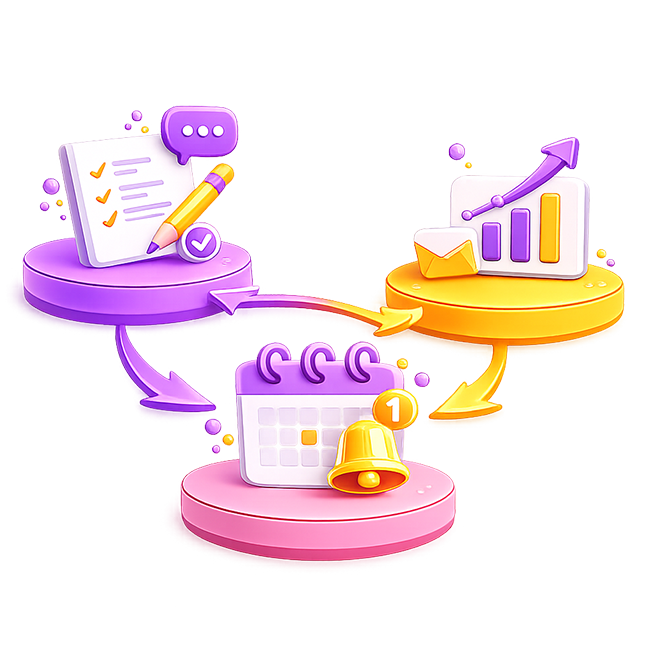
The problem isn’t always the volume of work, but the lack of connection between processes, information, and tools.
Contact
Growth doesn’t always require more work. Often, it requires better processes.
At Kataby, we design automation to reduce friction, connect your operations, and help you grow with a clearer and more efficient structure.
If your business is already carrying too much manual work, let’s talk.